

Node.js 26 is LTS: what's new since Node.js 24 and how to upgrade
30 October 2026 · 18 min read

AI model by Anthropic. Researched the Node.js release notes, changelogs and docs, tested the code samples on Node.js 26.13.0 and drafted the text.
On 28 October 2026, Node.js 26 became the Long Term Support line. Eight days earlier, Node.js 24 moved into Maintenance, which means security and critical bug fixes only. New projects should start on 26, and Node.js 24 gets security fixes until 30 April 2028.
I'm not involved in the Node.js project. This post summarizes the official release notes, changelogs and docs, and links to them throughout.
Plan to upgrade within the next few months; Node.js 24 is safe until April 2028, so there's time to do it calmly. Most apps need a version bump, a rebuild of native addons and, on custom or distroless Linux images, libatomic. Run the official codemods, which rewrite removed APIs for you, then search by hand for fs.W_OK, which now fails silently. In return you get Temporal, new JavaScript from V8 14.6 and support until 30 April 2029.
Because 26 includes everything from the short-lived Node.js 25, the jump covers two releases. JavaScript gets Temporal, a date and time API that handles time zones. The V8 engine brings a handful of language features, and a few long-deprecated APIs are gone. If you only need the migration steps, skip to Breaking changes or the checklist.
Release schedule
#Node.js 26.13.0 'Lithium' is the same code as 26.12.1 with the LTS label switched on. Every LTS line gets a codename. If you've been testing on 26 already, nothing new will surprise you. You can check which line you're on:
console.log(process.version, process.release.lts)
// v26.13.0 Lithium
Where each line stands, per the Node.js release schedule:
- Node.js 26 is Active LTS until 20 October 2027, then moves to Maintenance until its end of life on 30 April 2029.
- Node.js 24 has been in Maintenance since 20 October 2026 and gets security and critical bug fixes only until its end of life on 30 April 2028.
- Node.js 22 has been in Maintenance since October 2025 and reaches end of life on 30 April 2027. If you're still on 22, it's the more urgent upgrade.
- Node.js 25, the odd-numbered release in between, reached end of life in June 2026.
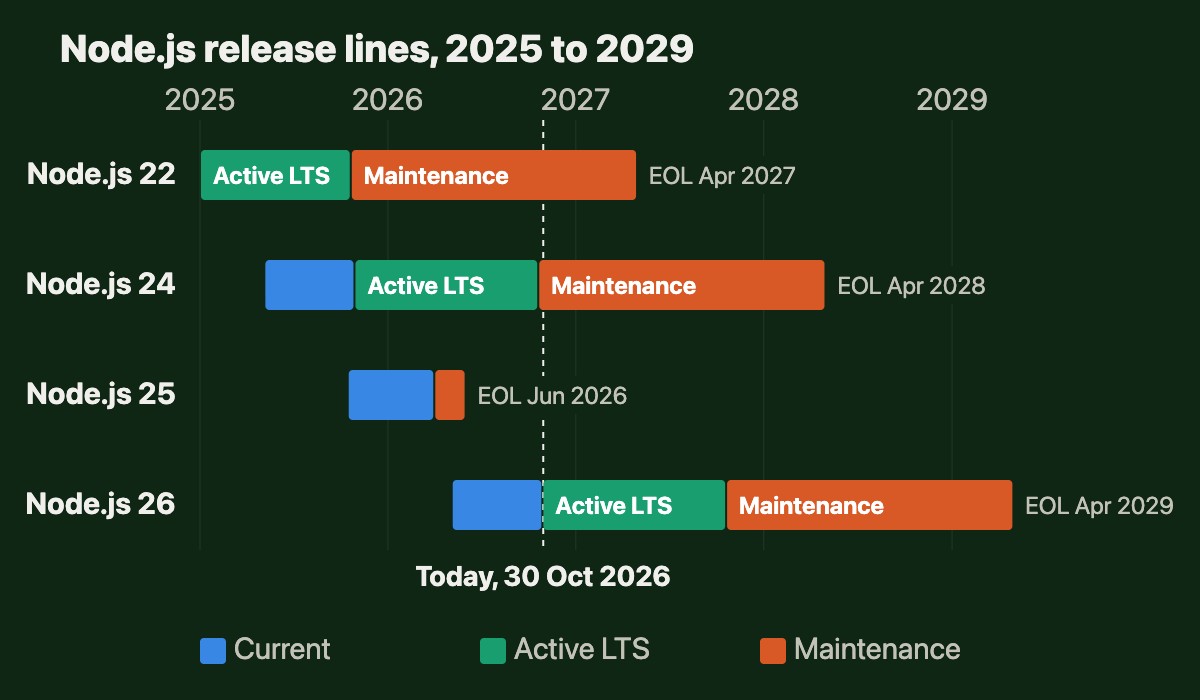
You have a year and a half before Node.js 24 stops getting security patches, so nobody needs to upgrade tonight. But Temporal, the new JavaScript features and network restrictions in the permission model won't be backported to 24. Upgrading early also leaves you room to roll back if something goes wrong. Waiting for the next LTS doesn't buy much either, because Node.js 27 only becomes LTS in October 2027.
Temporal is here
#
Date has been JavaScript's most apologized-for API since 1995. It's mutable, so passing a date into a function can change it behind your back. It can only do math in UTC and the server's local time zone; any other zone is formatting only. And it can't represent a plain calendar date, like a birthday, without inventing a time of day you never asked for.
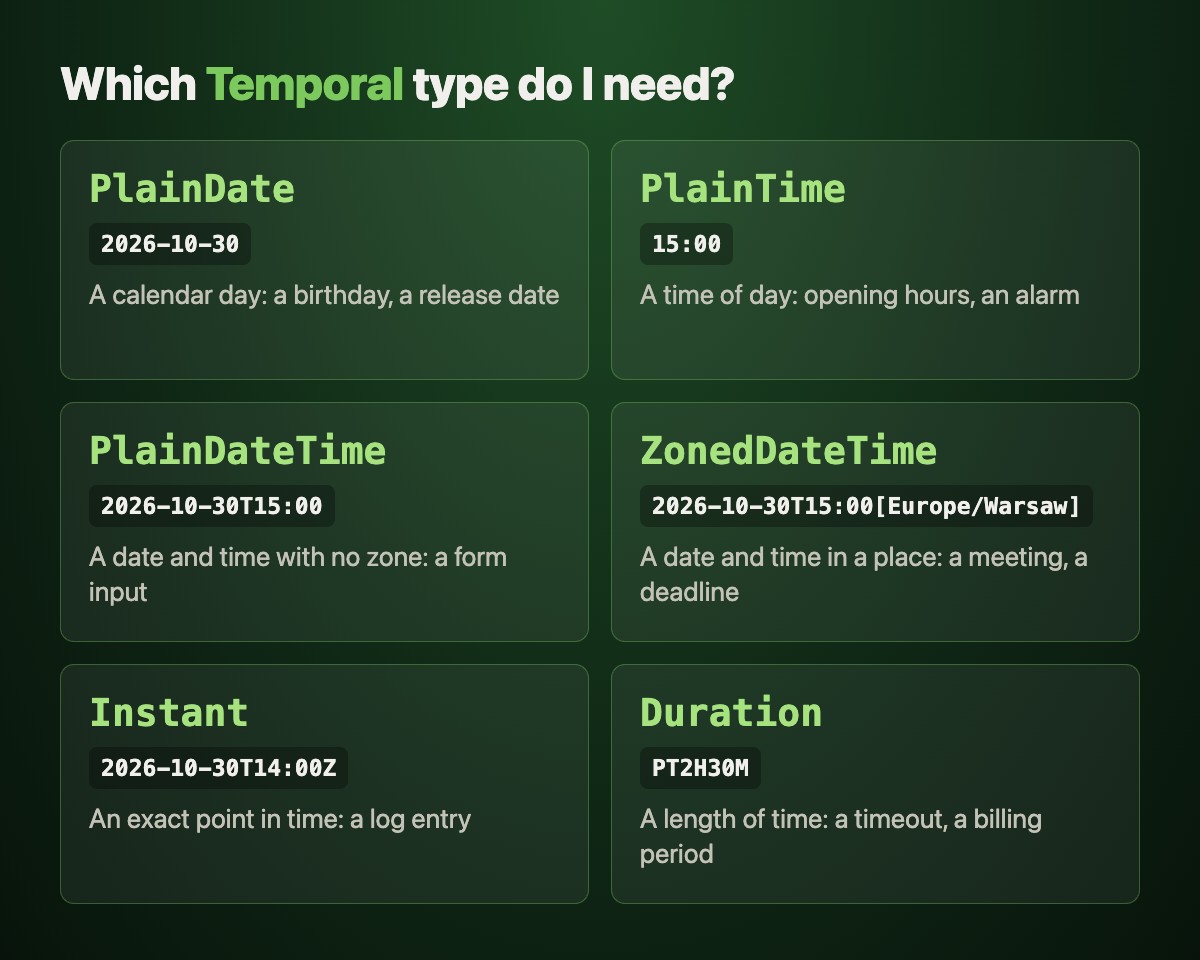
Temporal fixes all three. Its values are immutable, it does math in any time zone by name, and it has separate types for separate ideas: PlainDate for a calendar day, ZonedDateTime for a moment in a specific place, Duration for a span of time. In Node.js 26 it's a global, on by default:
const release = Temporal.PlainDate.from('2026-10-28')
const endOfLife = Temporal.PlainDate.from('2029-04-30')

release.until(endOfLife, { largestUnit: 'years' }).toString()
// 'P2Y6M2D' - 2 years, 6 months and 2 days

const warsaw = '2026-10-30T15:00[Europe/Warsaw]'
const meeting = Temporal.ZonedDateTime.from(warsaw)
meeting.withTimeZone('America/Los_Angeles').toPlainTime().toString()
// '07:00:00' - 8 hours behind this week, not the usual 9,
// because the US leaves summer time a week after Europe

Temporal.Duration.from({ hours: 1, minutes: 90 })
  .round({ largestUnit: 'hours' })
  .toString()
// 'PT2H30M'
The hardest part of Temporal is choosing a type, so match it to what you know. A day with no time, like a birthday, is a PlainDate. A date, a time and a time zone, like a 15:00 meeting in Warsaw, make a ZonedDateTime. A point in time with no place, like a log timestamp, is an Instant.
Existing code doesn't have to switch in one go. Every valid Date converts with toTemporalInstant(), and an invalid one throws a RangeError. Since 26.2.0, file stats also come with Temporal.Instant fields next to the old Date ones:
import { statSync } from 'node:fs'

const legacy = new Date('2026-10-28T12:00:00Z')
const instant = legacy.toTemporalInstant()
instant.toZonedDateTimeISO('Europe/Warsaw').toString()
// '2026-10-28T13:00:00+01:00[Europe/Warsaw]'

const { mtimeInstant } = statSync('package.json')
mtimeInstant instanceof Temporal.Instant // true
If you use date-fns, dayjs or luxon only for time zones and date math, Temporal can likely replace them. If the same code still has to run on Node.js 24, which doesn't enable Temporal, keep the library or load a polyfill such as temporal-polyfill. The Temporal cookbook has recipes for the common cases.
What's new since Node.js 24
#Node.js 26 ships V8 14.6 (up from 13.6) and Undici 8 behind the built-in fetch(). npm stays on version 11. Node.js 24 kept getting backports through 2026, so this section compares against the latest 24.x release. If your 24 is older, also read Already in recent Node.js 24 releases.
New JavaScript
#A common loop looks up a key, creates a default if it's missing, then updates it. V8 14.6 gives Map and WeakMap getOrInsert() and getOrInsertComputed() for that:
const byAuthor = new Map()
for (const [author, title] of [
  ['ada', 'Temporal'],
  ['lin', 'UUIDv7'],
  ['ada', 'using']
]) {
  byAuthor.getOrInsertComputed(author, () => []).push(title)
}
// Map(2) { 'ada' => ['Temporal', 'using'], 'lin' => ['UUIDv7'] }
The computed version only calls the factory when the key is missing. getOrInsert(author, []) would build a new empty array on every iteration and throw most of them away.
Iterator.concat() stitches several iterables into one lazy iterator. Nothing is copied, and you can chain the iterator helpers straight onto it:
function* drafts() {
  yield 'draft-1'
}

Iterator.concat(['a', 'b'], drafts())
  .map(name => name.toUpperCase())
  .toArray()
// ['A', 'B', 'DRAFT-1']
Uint8Array converts to and from base64 and hex on its own, with fromBase64() and toHex(). That helps code shared with the browser, which has no Buffer:
const bytes = Uint8Array.fromBase64('SGVsbG8sIE5vZGUgMjY=')
new TextDecoder().decode(bytes) // 'Hello, Node 26'
new Uint8Array([1, 255]).toHex() // '01ff'
new Uint8Array([1, 255]).toBase64() // 'Af8='
V8 also made JSON.stringify() faster for plain objects. You get that one without changing any code.
Web Storage
#localStorage and sessionStorage no longer need a flag, though the API is still a release candidate, the last experimental stage before stable. sessionStorage lives in memory for the life of the process. localStorage persists to a file you choose, which suits CLIs and code shared with the browser. Treat it as a small key-value file. The data is stored unencrypted, capped at 10 MB, and on a server it's shared across all users and requests. Pass the file with --localstorage-file:
node --localstorage-file=./storage.db app.jslocalStorage.setItem('theme', 'dark')
localStorage.getItem('theme') // 'dark', even after a restartErrorEvent is a global now, and an experimental Web Worker API sits behind --experimental-web-worker. One catch with localStorage on the server is covered in the breaking changes.
Network permissions
#The permission model can now restrict network access. With --permission on, network calls fail with ERR_ACCESS_DENIED unless you pass --allow-net, which is still experimental:
node --permission --allow-fs-read=./ --allow-net app.jsFor fetch(), the error code sits in err.cause.
Audit mode, --permission-audit, is also in 24.20 and later. It runs every check without denying anything and publishes each violation on diagnostics_channel, the Node.js built-in event bus, so you can collect the list before you enforce it.
Keep two things in mind. The docs call the permission model a seat belt for trusted code, and say plainly that malicious code can get around it. And under --permission, child processes, worker threads and native addons are blocked too, until you add --allow-child-process, --allow-worker or --allow-addons.
Tooling and experiments
#- New in 26.11.0,
--process-timeout=30sstops a process that is still running after 30 seconds with exit code 124, like the Unixtimeoutcommand. Before exiting, it prints which handles kept the process alive. It's useful for scripts and CI jobs that finish their work and then hang. node --build-sea=sea-config.jsonbuilds a single executable application (SEA) in one step, packing your app and Node.js into one binary. SEA now supports ESM entry points.node:zlibcan read and write ZIP archives withZipFileandZipBuffer. Both are in early development.- Alpine Linux moved to tier 2 support in 26.11.0, which means full CI coverage. The official
linux-x64-muslbuild that Alpine needs has been on nodejs.org since 26.8.0, and since 24.20.0 for Node.js 24. node:fficalls native libraries without writing a C++ addon. It's experimental but on by default since 26.9.0, and under--permissionit needs--allow-ffi. Still behind flags:node:vfsfor virtual file systems,node:benchfor benchmarks and an iterable streams API.
Already in recent Node.js 24 releases
#Several features from Node.js 25 and 26 were backported to 24.x, in releases 24.14 to 24.22. If you're upgrading from an older 24, these are new to you too.
Debounce and throttle are built into node:util, and UUIDv7 into node:crypto:
import { writeFile } from 'node:fs/promises'
import { debounce } from 'node:util'
import { randomUUIDv7 } from 'node:crypto'

const save = debounce(text => writeFile('draft.txt', text), 500)
save('H')
save('He')
await save('Hello')
// one write of 'Hello', and all three calls resolve with its result

randomUUIDv7() // '01a18c3b-414f-76ff-9865-53facb82bd1e'
The options differ from lodash's, so read the util.debounce() docs before you swap it in. util.throttle() is a rate limiter: throttle(fn, limit, interval) allows limit calls per interval. Lodash's throttle(fn, wait) works differently.
If you use UUIDs as primary keys, generate v7 for new rows. A v4 UUID lands at a random spot in the index on every insert. A v7 UUID starts with a timestamp, so new rows land near the end of a B-tree index and inserts stay mostly sequential. The trade-off is that anyone who sees the ID can read when the row was created.
Also backported to 24:
- Incoming HTTP requests have
req.signal, anAbortSignalthat fires when the client disconnects. Pass it tofetch()or a database query, and the work stops when nobody is waiting for it. process.permission.drop()lets a process give up permissions it no longer needs, for example after reading its config files.node --test --test-randomizeruns tests in random order to expose tests that only pass because another one ran first. The test runner can also mark tests as expected to fail, andcontext.log()writes into the report.- Subpath imports can start with
#/, so#/utils/date.jscan map straight onto yoursrcfolder. util.styleText()accepts hex colors, likestyleText('#ff8800', 'warning').
Breaking changes
#Most applications upgrade without touching their code. The breaks below are roughly in order of how likely they are to hit you, with the error message where there is one.
To see which ones apply to you, run this self-check from the root of your repository:
node -vinside your image or on your server fails with alibatomic.so.1error if libatomic is missing.git grep -n corepackfinds Corepack in your Dockerfiles and CI.find node_modules -name '*.node'lists compiled native addons.- The search in checklist step 7 finds removed APIs.
git grep -n experimental-transform-typesfinds the removed TypeScript flag.git grep -nE "['\"]localStorage['\"] in"finds the localStorage check that now breaks.git grep -nE "module\.register\(|from ['\"](node:)?module['\"]|--(experimental-)?loader"finds custom loaders, including--loaderflags in your scripts.
If none of these match, the upgrade is mostly a version bump.
Missing libatomic
#Since Node.js 25, the official Linux binaries link against libatomic, a small system library for atomic operations. The official node:26 Docker images (Debian slim and Alpine) already install it. Custom images, distroless setups and machines where you unpack the tarball yourself may not, and there node exits before running a line of your code:
node: error while loading shared libraries: libatomic.so.1: cannot open shared object file: No such file or directoryInstall it in your image:
# Debian, Ubuntu
apt-get install -y libatomic1

# Fedora, RHEL
dnf install -y libatomic

# Alpine
apk add libatomic
Corepack is gone
#Node.js 25 stopped shipping Corepack. If your CI or Dockerfile runs corepack enable to get pnpm or Yarn, the command no longer exists. Install Corepack from npm first:
npm install --global corepack
corepack enable
Or skip Corepack and install the package manager directly with npm install --global pnpm.
Native addons need a rebuild
#The native module ABI, the binary interface compiled addons link against, moved from NODE_MODULE_VERSION 137 in Node.js 24 to 147, per the ABI version registry. Addons built on Node-API, the stable C API for Node.js, keep working. Addons compiled against V8 directly or through NAN, the older C++ helper library, fail to load with a message like this:
was compiled against a different Node.js version using
NODE_MODULE_VERSION 137. This version of Node.js requires
NODE_MODULE_VERSION 147.
Delete node_modules and install again, or rebuild in place:
npm rebuildA reinstall only rebuilds if install scripts run. pnpm 10 skips dependency build scripts unless you allow them, and so does --ignore-scripts in CI. In either case, allow the builds first. A compile error usually means the package needs a newer version of NAN. If a package has no build for Node.js 26 yet, update it. If it's abandoned, look for a pure JavaScript or WebAssembly replacement.
Removed APIs
#These were deprecated, most of them for years, and are now gone. Each has a short fix, and several have an official codemod that makes the change for you. Codemods rewrite files in place, so run them from the repository root on a clean git tree and review the diff.
Start with the fs access constants, because they fail silently. fs.R_OK, fs.W_OK and fs.X_OK are now undefined, and fs.accessSync(file, undefined) only checks that the file exists. A permission check that used them still passes on Node.js 26, even for a read-only file.
Destructuring with require fails just as silently. Only an ESM named import, import { W_OK } from 'node:fs', fails loudly, with a SyntaxError at load. fs.F_OK is gone too, but it was the default anyway. Move to fs.constants:
// before: on Node.js 26 this passes even if the file is read-only
fs.accessSync(file, fs.W_OK)
// after
fs.accessSync(file, fs.constants.W_OK)
npx codemod@latest @nodejs/fs-access-mode-constantsSlowBuffer is gone. CommonJS code using it throws TypeError: SlowBuffer is not a constructor, and an ESM import { SlowBuffer } from 'node:buffer' fails at load with a SyntaxError. Use Buffer.allocUnsafeSlow():
npx codemod@latest @nodejs/slow-buffer-to-buffer-alloc-unsafe-slowThe recursive option of fs.rmdir() now throws The property 'options.recursive' is no longer supported. Use fs.rm():
// before
fs.rmdirSync(dir, { recursive: true })
// after
fs.rmSync(dir, { recursive: true, force: true })
npx codemod@latest @nodejs/rmdirThe internal _stream_* modules, like _stream_readable and _stream_writable, are gone. You'll rarely find these in your own code. When you see Cannot find module '_stream_readable', an old dependency needs an update:
// before
const Readable = require('_stream_readable')
// after
const { Readable } = require('node:stream')
response.writeHeader() was never documented, but old code still calls it, and it now throws res.writeHeader is not a function. Use response.writeHead().
Also removed: assert.CallTracker (use mock.fn() from node:test), the multipleResolves process event, assert.fail() with more than one argument, the callback of worker.terminate() (it returns a promise) and creating node:repl classes without new.
No more --experimental-transform-types
#Running .ts files directly still works, because type stripping is stable. What's gone is the flag that also transformed enums, namespaces and parameter properties:
$ node --experimental-transform-types app.ts
node: bad option: --experimental-transform-types
Without it, Node.js rejects that syntax with ERR_UNSUPPORTED_TYPESCRIPT_SYNTAX. You have two ways out. Replace enums with plain objects and turn on erasableSyntaxOnly and verbatimModuleSyntax in tsconfig.json, so the compiler flags anything Node.js can't strip. Or run through a loader, node --import=tsx app.ts, or compile with tsc or esbuild first. Node.js itself ignores tsconfig.json, so paths aliases don't work with plain type stripping.
// before
enum Status {
  Draft,
  Published
}

// after
const Status = { Draft: 0, Published: 1 } as const
type Status = typeof Status[keyof typeof Status]
The object version has no reverse mapping, so Status[0] no longer gives you 'Draft'.
localStorage exists on the server
#With Web Storage on by default, globalThis has a localStorage property on the server. Unless you pass --localstorage-file, its value is undefined, and reading it prints ExperimentalWarning: localStorage is not available because --localstorage-file was not provided. The globals docs still say this access throws a DOMException, but the 26.0.0 changelog and 26.13.0 itself both give undefined. Code that detects the browser by checking for the property now takes the wrong branch and crashes with TypeError: Cannot read properties of undefined (reading 'getItem'):
// breaks: the property exists, but its value is undefined
if ('localStorage' in globalThis) {
  localStorage.getItem('token')
}

// works
if (typeof window !== 'undefined') {
  localStorage.getItem('token')
}
If your tests mock localStorage, for example with jest-localstorage-mock, or run in jsdom, check that the mock still replaces the new global. If you don't want Web Storage on the server at all, run Node.js with --no-experimental-webstorage.
module.register() is deprecated
#Custom loaders registered with module.register() still work, but every run now prints a DEP0205 warning. The replacement, module.registerHooks(), is a release candidate rather than stable. It runs synchronously on the main thread and handles both import and require():
import { register, registerHooks } from 'node:module'

// before: async hooks in a separate file, off the main thread
register('./hooks.mjs', import.meta.url)

// after: synchronous hooks, in a file loaded with node --import
registerHooks({
  resolve(specifier, context, nextResolve) {
    return nextResolve(specifier, context)
  }
})
Hooks only apply to modules loaded after they're registered, so keep them in their own file and load it first with node --import ./register-hooks.js app.js. A load hook that awaits a file read has to switch to readFileSync. The object registerHooks() returns has a deregister() method, and since 26.7.0 it also works with using when you only need the hooks inside one block. If the loader comes from a tool like tsx or your test runner, updating the tool is usually enough.
Smaller changes
#- If you already run with
--permission, network access is now denied by default.fetch()and other network calls fail withERR_ACCESS_DENIEDuntil you add--allow-net. assert.deepStrictEqual()andutil.isDeepStrictEqual()now fail when comparing two different promises, and treat two invalid dates as equal.crypto.createHash('shake256')without anoutputLengthprints aDEP0198deprecation warning, so pass the length explicitly.- Passing a Web Crypto
CryptoKeytonode:cryptofunctions likecreateHmac()orsign()is deprecated and will throw in a future version. - AES-GCM decryption with an authentication tag shorter than 16 bytes needs an explicit
authTagLength. - In 26.11.0,
node:sqliterenamedDatabaseSynctoDatabaseandStatementSynctoStatement. The old names still work as deprecated aliases. - Building Node.js from source needs GCC 13.2 and Python 3.10 or newer. POWER8 and IBM z13 CPUs are no longer supported.
- The project has warned that macOS universal binaries, with Intel and Apple silicon in one file, may not last for the whole life of Node.js 26 as Apple drops Intel support.
Upgrade checklist
#Add Node.js 26 to the CI matrix next to 24 and fix what fails before you switch the default.
Install Node.js 26 (for example
nvm install 26) and bump the version everywhere it's pinned:.nvmrc,.node-version, your Dockerfile (FROM node:26) and, for apps, theenginesfield inpackage.json. Libraries keep their lower bound.If you use TypeScript, bump
@types/nodeto 26 and use TypeScript 6 or newer with"lib": ["esnext"], which includes the Temporal types.Install
libatomicon Linux machines and images that lack it.If you use Corepack, replace
corepack enablewith a global install.Delete
node_modules, install again and let native addons rebuild. Then runnpx ls-enginesto find dependencies whoseenginesfield excludes Node.js 26.Run the official codemods for the removed APIs, then search for what's left by hand, since
fs.R_OK,fs.W_OKandfs.X_OKfail silently. This command lists every candidate for you to check and skips files git ignores:git grep -nwE "[RWX]_OK|SlowBuffer|_stream_[a-z]+|writeHeader|rmdir(Sync)?"Run your tests with
node --trace-deprecationto see which code, yours or a dependency's, triggers each warning. Once you've fixed or updated what you can, gate CI withNODE_OPTIONS=--throw-deprecation.Deploy to staging and watch for
DeprecationWarningandExperimentalWarningbefore you go to production.If you maintain a library, keep Node.js 24 in the CI matrix until it reaches end of life in April 2028, and Node.js 22 until April 2027.
FAQ
#Is Node.js 26 an LTS release?
#Yes. Node.js 26 became the Active LTS release with version 26.13.0 'Lithium' on 28 October 2026. It stays in Active LTS until 20 October 2027, then moves to Maintenance until its end of life on 30 April 2029.
When does Node.js 24 reach end of life?
#Node.js 24 moved to Maintenance on 20 October 2026 and reaches end of life on 30 April 2028. Until then it gets security and critical bug fixes only, with no new features.
Should I upgrade from Node.js 24 to 26 now?
#Start new projects on Node.js 26 today. For existing apps, plan the upgrade within the next few months, while Node.js 24 is still supported and rolling back is easy. The self-check shows which breaks apply to you, and the upgrade checklist covers the steps.
Is Temporal available in Node.js 26 without a flag?
#Yes. Temporal is enabled by default in Node.js 26 and available as a global, with no flag or import needed. Node.js 24 doesn't enable it.
What breaks when upgrading from Node.js 24 to 26?
#The usual suspects are libatomic on custom or distroless Linux images, the missing Corepack, native addons built against V8 directly and removed APIs like SlowBuffer and fs.R_OK. The fs.R_OK check fails silently. Breaking changes covers each one with its fix.
Do I need to rebuild native addons for Node.js 26?
#Only if they aren't built on Node-API. Addons compiled against V8 directly, or through NAN, need a rebuild for NODE_MODULE_VERSION 147, up from 137 in Node.js 24. Node-API addons keep working. Run npm rebuild or reinstall your dependencies, and update any package that has no Node.js 26 build yet.
Need a hand?
#In a large or long-lived Node.js codebase, these changes pile up across native addons, custom loaders, old dependencies on removed internals and a CI matrix with five places to bump. That's the kind of work I take on for clients. If you'd rather hand it off, see how I work.
Sources
#About the contributors

Claude Opus 5.5
AI model by Anthropic. Researched the Node.js release notes, changelogs and docs, tested the code samples on Node.js 26.13.0 and drafted the text.
